Ducks don’t come to you—they follow instinct, weather, and food. If you want success in waterfowl hunting, you must go to them. The best hunters aren’t the ones with the loudest calls or biggest spreads; they’re the ones who understand location, concealment, motion, and calling—in that exact order. These four principles form the core of every successful hunt. Ignore one, and your odds plummet. Master all four, and even a slow day can turn into a limit.
Whether you’re a beginner or refining your edge, these waterfowl hunting tips will help you kill more birds, stay safe, and enjoy the deep satisfaction of the hunt. From scouting hidden sloughs to building undetectable blinds and using motion rigs that fool wary mallards, this guide delivers field-tested strategies that work—where and when it matters most.
Find the Right Location: Ducks Follow Patterns, Not Promises
Your success starts long before sunrise—with your choice of hunting spot. No amount of gear or skill can overcome poor location. Ducks travel predictable routes, and knowing where they’ll be—and why—is half the battle.
Track Migration Flyways and Weather Windows
Waterfowl move along four major North American flyways: Pacific, Central, Mississippi, and Atlantic. These corridors funnel millions of ducks south each fall, seeking open water and food. Positioning yourself along or near these flyways dramatically increases your odds.
Southern Missouri, for example, sees heavier duck traffic than eastern Tennessee at the same latitude because it lies within the Mississippi Flyway. Ducks migrate when northern waters freeze and food disappears—most movement happens after cold fronts push through, dropping temperatures and driving flocks hundreds of miles overnight.
Monitor weather patterns closely. A strong cold front from Canada can trigger massive movements. Use apps like MyRadar, Weather Underground, and Windy to track wind direction, temperature drops, and storm systems. Combine this with USGS water data (waterdata.usgs.gov) to identify rising water levels—flooding lifts food like smartweed and wild celery, making it accessible and attracting ducks.
Scout Like a Pro—Before You Hunt
Expect to spend 2–3 days scouting for every day you hunt. Use binoculars from high vantage points—dams, levees, or boat ramps—to scan large areas. Look for afternoon landings; these often mark roost sites. Then return at dawn to watch where birds fly from—those are your feeding zones, the best places to set up.
Mark productive spots with GPS and revisit them often. Conditions change fast—water levels rise or fall, wind shifts flight paths, and other hunters can pressure birds. Stay flexible.
Set Up with the Wind and Sun in Mind
Always position yourself with the wind at your back. Ducks land into the wind, so aligning your blind gives you longer, safer shot presentations. Avoid having the sun in your face during early morning or evening hunts—glare reduces visibility and makes concealment harder.
Plan your access route in advance. A perfect spot is useless if you can’t reach it quietly. Some require hiking, others kayaks or ATVs. Arrive the day before if needed to avoid noise and confusion in the dark.
Stay Hidden: If Ducks See You, You’ve Already Lost
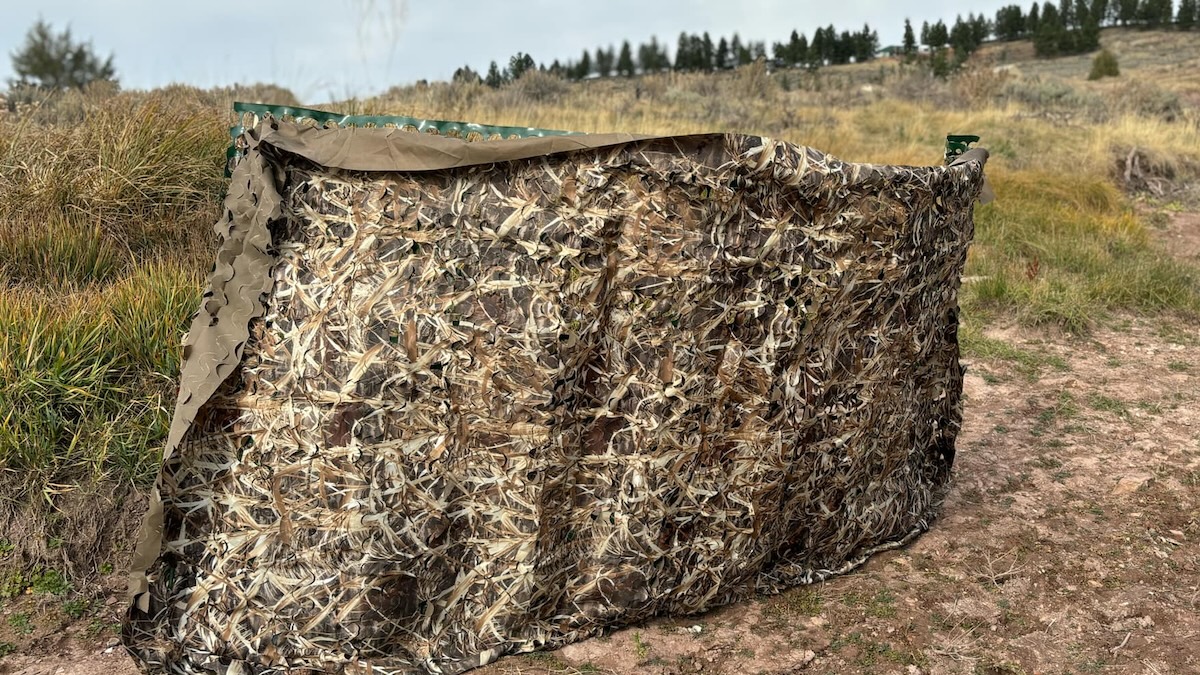
Ducks have exceptional vision—they see color, detect movement, and notice unnatural shapes. Even a glint off a watch or a boot sticking out of the blind can spook them.
Dress for Total Concealment
Wear camouflage that matches your environment: grassy patterns for fields, timber designs for woods. Avoid bright colors, tight-fitting clothes, or reflective gear. Cover your face with a facemask, paint, or hood—skin reflects light and moves, two things ducks detect instantly.
Build Natural-Looking Blinds
Use local vegetation: cattails in marshes, corn stubble in fields. Place materials unevenly—nature isn’t symmetrical. Avoid right angles, flat walls, or solid lines. In flooded timber, use tree trunks and branches as natural cover. Skip artificial blinds when possible.
On open flats, an old refrigerator box or pop-up blind works if painted and broken up with brush. Always conceal the top of your blind—ducks look down as they circle.
On sunny days, hunt the shaded side of trees or structures. Light creates contrast, revealing edges.
Avoid Common Detection Traps
Hide boats at least 100 yards away before daylight. A floating outline in the pre-dawn gray screams “trap.” Pick up spent shells and tuck decoy cords under mud or grass—exposed lines look unnatural.
If ducks circle but won’t commit, they’ve seen something wrong. It might be a boot, a gun barrel, or a shadow. Fix it before next time.
Pro tip: “I once lost a flock because my water bottle reflected the sunrise. Now I wrap everything in camo tape.”
Add Realistic Motion to Your Decoys
Static spreads fail. Live ducks move—swimming, diving, feeding. Your decoys should too.
Why Motion Works
Motion makes your spread visible from a distance and signals safety. On calm days, when wind doesn’t ripple the water, motion becomes essential. It draws eyes and builds confidence.
Start with 12–24 decoys—used or budget models are fine. Tether all to prevent drifting.
Use Jerk Strings for Natural Action
A jerk string is a simple, effective motion tool. Attach it to 3–4 decoys with a bungee system and anchor it to the bottom. Pull it by hand to create swimming and diving action.
You can build one:
– Use a broomstick handle tied to decoy cord.
– Add 5 inches of surgical tubing and a D-ring clipped to a grapnel.
– Install four fishing swivels 4 feet apart.
– Tie decoys to swivels with foot-long lines—lets them move naturally while hiding the cord.
Store it wrapped on a thin board with half-circle cuts at each end.
Jerk strings are lightweight, cheap, and deadly effective—especially in kayaks or small blinds.
Try Pulsators and Other Motion Tools
Pulsators use bilge pumps or Weasel Balls to create ripples across the spread. More natural than spinners and less likely to spook late-season birds.
Spinning wing decoys mimic landing ducks but are expensive and illegal in some states. Use sparingly, if at all.
Silhouette decoys in a “Y” pattern create illusion of movement as birds fly past. Great for dry fields.
Hunter insight: “I built four pulsators for less than two store-bought ones. They lasted three years. But I still bring two jerk strings—one regular, one with a spreader rig. Simple, bombproof, and easy to carry.”
Call with Purpose, Not Noise
Calling isn’t magic. It’s communication. And like any language, timing and tone matter.
Start with the Right Calls
Buy three:
– Two mallard hen calls (one soft, one loud)
– One 6-in-1 drake whistle
Total cost: under $100. Top beginner brands: Duck Commander, Haydel’s, Primos, Buck Gardner.
Use a lanyard. Keep them warm and dry—cold calls crack.
Mallard sounds work on most species—pintails, wigeon, even teal respond.
Master Three Basic Hen Calls
Quack
“I’m here and safe.”
Technique: Pucker lips, tighten cheeks, blow from diaphragm. Sound like “VUT” or “VOOT.” Use occasionally to maintain confidence.
Hail/Comeback Call
“Come join me.”
3–5 quacks, fast and loud at first, then softer and quicker: QUACK—quack-quackquackquack. Use to grab distant birds.
Chuckle/Feed Call
“I’m eating and happy.”
Fast “DUKDUKDUK” with tight mouth. Cup your hand over the call end (not flared) for a rich, mellow tone.
Use the Drake Whistle Wisely
Mimics male mallard sounds. Not a primary attractant, but adds realism. Hum lightly while blowing—creates a soft, buzzy note. Use when birds are working overhead.
Read the Birds, Not Your Call Sheet
- Coming in? Call less. Soft quacks only.
- Passing by? Hit them with a loud hail.
- Circling? Vary your sequence:
- Soft quacks when they turn toward you
- Chuckles when overhead
- Hail call if they start to leave
Key insight: “Call with purpose, not frequency. One well-timed sequence beats 20 minutes of nonstop quacking.”
Run-and-Gun: Mobile Hunting for Real Results
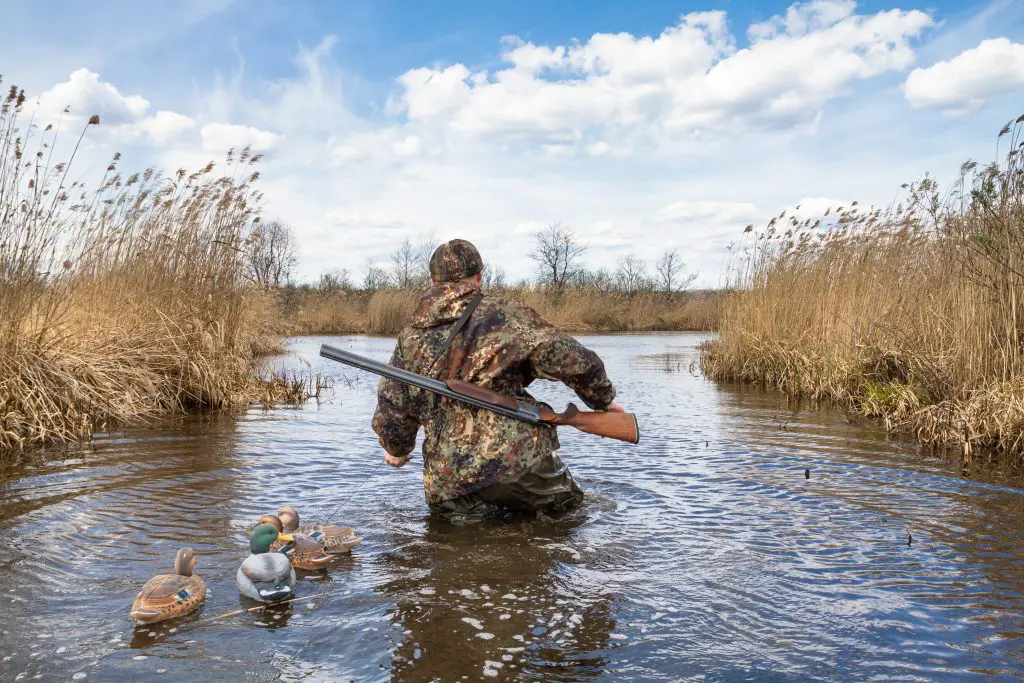
When public land is crowded or birds are scattered, go mobile.
Hunt Where Others Won’t
Use onX or similar apps to find small ponds, flooded backwaters, or temporary rain-filled ditches miles from main areas. These “blue dots” often hold birds ignored by stationary hunters.
Target flight paths between roosts and feeding zones—especially those leading away from heavily hunted areas.
Evening hunts work best. Birds return to roosts predictably.
Pack Light, Move Fast
- Decoy transport: Backpack (best), sled, or kayak
- Decoys: 6–18 floaters + 1 motion decoy (pulsator preferred)
- Clothing: Layerable system—First Lite LZ Jacket, Origin Hoody, Tundra Neck Gaiter
- Pattern: Cache pattern blends in most environments
- Footwear: LaCrosse Boots for hiking; uninsulated fishing waders (earth tones) unless freezing
- Blind: Often none—use natural cover. Bring a lightweight chair to stay still.
Hunter insight: “A three-bird day is a great day. Even one bird is a win. I take the road less traveled—one bird at a time.”
Gear That Works: Smart Choices for Real Hunters
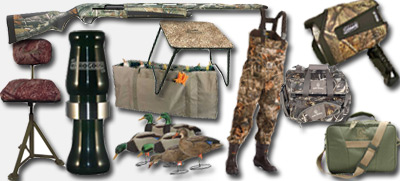
Your equipment should serve the hunt—not slow you down.
Shotguns and Chokes
- 12-gauge is standard; 20-gauge for lighter recoil
- Semi-automatics load faster in blinds
- Remington 870—durable, reliable, decades of service
- Barrel length: 28” or 30”
- Choke: Modified for most situations
- Pattern your gun with your ammo—ethical kills depend on it
- Shell limit: 3 shells max (federal law)
Ammunition: Steel and Beyond
- Non-toxic shot required—no lead
- Steel is standard; bismuth and tungsten offer better patterns and energy
- Best load: 1 3/8 oz in 3” shell, 1,250–1,350 fps
- More pellets, tighter patterns, better energy at 20–30 yards
- Avoid high-velocity loads (>1,450 fps)—steel patterns break up
Only a few manufacturers make this balanced load—find them.
Clothing and Footwear
- Waterproof waders—get the right fit (too tight = leaks)
- One pair of socks only—wiggle toes for circulation
- Uninsulated fishing waders (earth tones) for hiking; insulated only in extreme cold
- Layering system essential for run-and-gun
- Eye protection: Hunters HD Gold lenses—boost contrast in low light
- Electronic hearing: Walker’s Disrupter earbuds—cut blast, amplify birds and calls
Final Note: Waterfowl hunting isn’t about gear or luck. It’s about showing up, adapting, and mastering the fundamentals. The best hunters aren’t the loudest—they’re the ones who listen, watch, and learn. And remember—snacks are the 5th principle.

0 Comments