You’ve invested in a hunting saddle—now what? Learning how to use a hunting saddle safely and efficiently transforms your hunting experience, offering mobility, stealth, and 360-degree shooting that traditional stands can’t match. Whether you’re a bowhunter chasing whitetails or a public-land predator hunter on the move, mastering the saddle opens new terrain and tactics. This guide walks you through every phase—from gear prep to climbing, shooting, and descending—with clear steps, safety protocols, and pro tips. By the end, you’ll know exactly how to set up, hunt from, and get down from a tree saddle with confidence.
Gear Up: Assemble Your Saddle System

Before climbing, ensure all components are ready and compatible. A complete hunting saddle setup relies on four core pieces working together seamlessly.
Select the Right Saddle for Your Build
Your saddle must fit snugly and distribute weight across hips, thighs, and lower back. Look for:
- Adjustable leg straps with T-hook buckles (right-side down for gravity lock).
- A freedom belt that secures the saddle in place without restricting movement.
- Bridge attachment point—a loop or ring where the tether connects.
- Optional yolk or suspenders to relieve hip pressure during long sits.
Pro Tip: Try saddles at different weights. Lightweight models like the Tethrd Mantis (1.2 lbs) suit minimalist hunters, while heavier ones like the Cruzr XC Super Saddle offer more padding and attachment points.
Match Your Platform to Shooting Hand
The platform supports your feet and stabilizes your stance. Mount it based on your dominant hand:
- Right-handed shooters: Attach platform on the right side of the tree.
- Left-handed shooters: Mount on the left.
- Left-eye-dominant right-handers may reverse for better weak-side shots.
Ensure the platform has an adjustable standoff and secure cam buckle. Popular options include the Tethrd Predator V and Profile Platform.
Prepare Ropes and Carabiners
Two ropes are essential:
- Lineman’s rope (climbing rope): Used during ascent/descent, attached via girth hitch to the saddle.
- Tree tether: Shorter loop (Amsteel or Oplux) wrapped around the tree at chest level for hunting.
Use only climbing-rated carabiners (e.g., Petzl Attache or Kong GiGi) with locking gates. Never substitute hardware.
Put On the Saddle Correctly
Wearing the saddle properly ensures comfort and safety.
- Step In: Hold the saddle so the bridge rope hangs between your legs.
- Pull Up: Lift the saddle into position like pants—bridge should sit behind your butt.
- Secure Freedom Belt: Fasten around your waist, snug but not tight.
- Latch Leg Straps: Click T-hooks into place, ensuring right-side buckles face down.
- Attach Yolk (if using): Connect to D-rings on the saddle to shift weight to shoulders.
Visual Cue: When tightened, you should be able to slide two fingers under each strap.
Hoist Your Bow First
Never climb with your bow in hand. Instead:
- Tie Off: Secure bow string and limbs to prevent damage.
- Use a Bow Hoist: Attach rope to bow’s carry handle or quiver mount.
- Pull Up: Hoist bow to hunting height before climbing.
- Stow Safely: Hang from H-strap once at elevation.
Why It Matters: Keeps hands free, prevents drops, and reduces noise.
Attach the Lineman’s Rope
This rope keeps you connected during climb and descent.
Install the Girth Hitch
- Feed the spliced end of the lineman’s rope through the lineman’s loop on the saddle.
- Pull the tail through to form a girth hitch—this permanently secures the rope.
- Test by pulling hard; the knot should not slip.
Critical Safety Step: The girth hitch is non-negotiable. It ensures you stay tied in at all times.
Connect the Prusik Knot
- Wrap the prusik cord around the main rope below your hands.
- Clip a locking carabiner to the opposite side of the lineman’s loop.
- Position prusik so it grips when weighted and slides when lifted.
Right-Handed Hunters: Place prusik on the right side for easier bow access during climb.
Install Climbing Sticks Safely
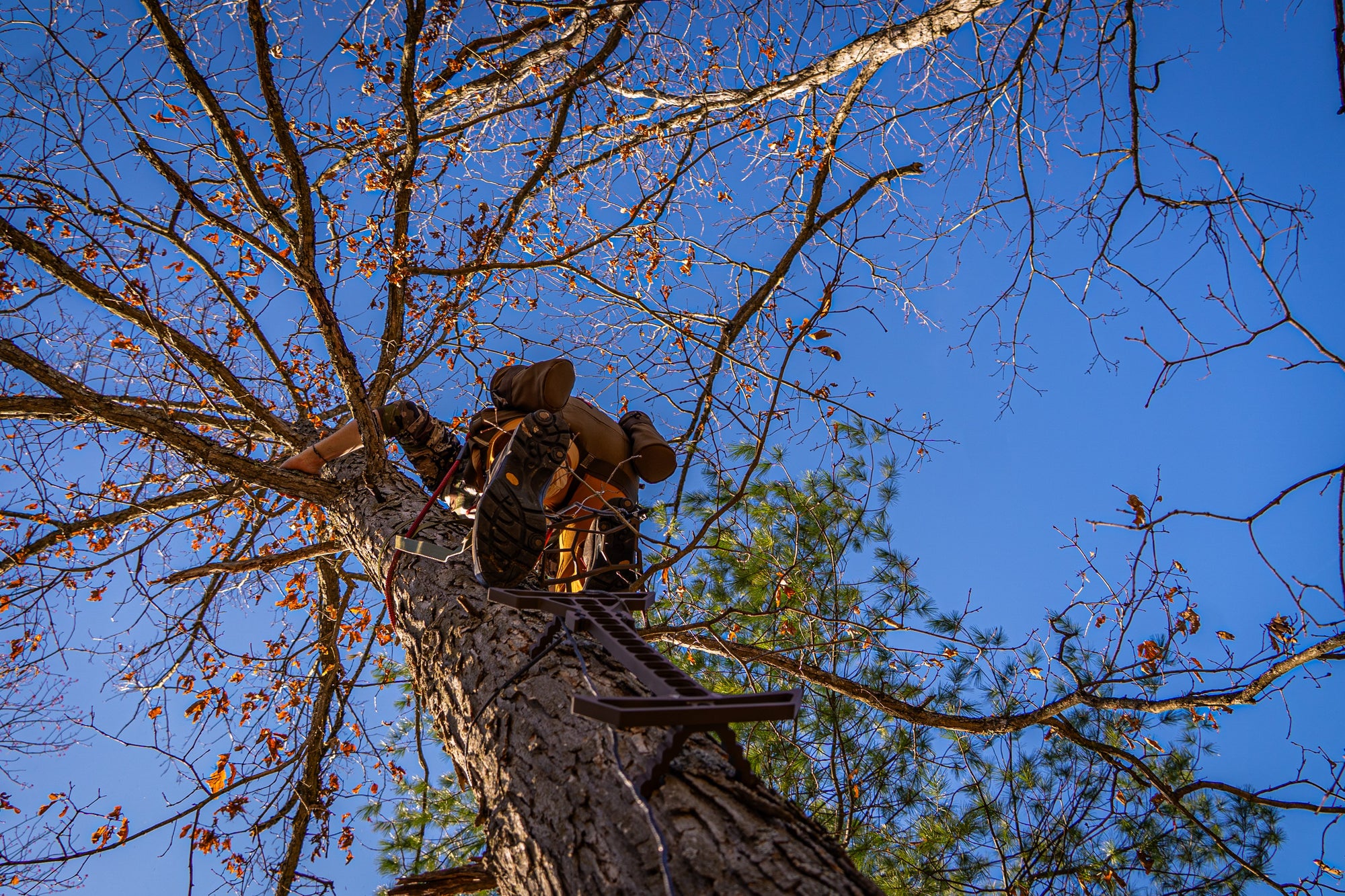
Climbing sticks act as portable ladder rungs.
Start Low and Build Up
- First Stick: Place at knee height (18 inches), wrap cable, and lock.
- Second Stick: Install at full arm’s reach above the first.
- Ascend: Step up, pull rope through prusik, and reposition.
Safety Visual: Always keep the lineman’s rope above your current stick.
Add Sticks as You Climb
- Carry 4–6 sticks (carbon fiber preferred for weight savings).
- After stepping onto a stick, install the next one above.
- Lean into the rope for balance while attaching.
Pro Tip: Use AM Steel Cleats instead of cam buckles—they resist slippage better.
Set the Platform at Hunting Height
Once at 15–25 feet, install your foot platform.
Position and Level
- Place platform level with or slightly above your top stick.
- Use adjustment bolt or thumb screw to fine-tune height.
Secure the Cam Buckle
- Wrap strap around the tree.
- Pull slack and lock the cam.
- Push down—listen for the “pop” that confirms secure engagement.
Warning: If no pop, re-tighten. A loose platform compromises stability.
Rigidify the Platform
- Step onto the standoff.
- Pull platform upward with your foot.
- Reset downward—this locks internal mechanisms.
Note: Platforms feel “squishy” until rigidified. Always perform this step.
Connect the Tree Tether
Now transfer your weight from the lineman’s rope to the tether.
Wrap and Girth Hitch
- Place the tether around the tree at chest to forehead level.
- Feed tail through the loop and pull tight to create a girth hitch.
Ideal Height: High enough to allow full rotation, low enough to avoid neck strain.
Clip and Transfer Weight
- Attach a locked carabiner to your bridge.
- Connect to the tether loop.
- Slowly lean back, shifting weight off the lineman’s rope.
- Once fully supported, unclip the lineman’s rope and stow in dump pouch.
Golden Rule: Always be double-connected during transfer—tether and lineman’s rope both engaged.
Hang Gear for Quiet Access
Organize gear to minimize noise and maximize reach.
Install an H-strap
- Wrap around the tree above or below the tether.
- Girth hitch and cinch tight.
- Clip gear hangers or S-hooks.
Arrange for Fast Access
- Right-handed shooters: Pack on the right, bow on the left.
- Left-handed shooters: Reverse the setup.
- Hang bow at shoulder height, riser facing out for punch-forward grab.
- Lay binoculars on pack flap for quick viewing.
Silence Tip: Use rubber-coated carabiners and felt-lined dump pouches.
Retrieve Your Bow
- Pull hoist rope to bring bow to height.
- Unclip from hoist and hang on H-strap.
- Test draw to ensure no tether interference.
Practice Drill: Simulate retrieval in your backyard before the hunt.
Shoot From the Saddle Confidently
Saddle hunting allows full 360-degree coverage with proper technique.
Face the Tree for Cover
Unlike treestands, you face the trunk. Use it as concealment while scanning.
Master Shooting Angles
- Strong-side (7:00–11:00 for right-handed): Easiest, most natural draw.
- Behind-the-tree (6:00): Rotate hips slightly and draw across the tether.
- Weak-side (1:00–5:00): Pivot body, press thigh into tree, and draw across.
Key Move: Draw across the tether rope, not under or around it.
Rotate Smoothly 360 Degrees
- Keep heels near platform edge.
- Walk feet slowly around the tree.
- Pivot hips toward the trunk.
- Press thigh into the tree for stability.
- Keep prusik close to carabiner for balance.
Result: With practice, you can track and engage game from any direction.
Practice Draw Mechanics
Drawing in a saddle differs from ground shooting.
Avoid Tether Interference
- Position tether so it doesn’t cross your draw path.
- Draw bow across your body, clearing the tether.
Train at Home
- Set up saddle in backyard at 5–6 feet.
- Practice drawing from all angles.
- Simulate sudden shots and tracking movements.
Pro Tip: Use a lighter draw weight during practice to build muscle memory.
Descend Safely: Step-by-Step
Coming down requires the same caution as climbing.
Reattach Lineman’s Rope
- Wrap around the tree.
- Clip into lineman’s loop.
- Lock carabiner.
- Take slack out of rope.
Double-Check: Ensure girth hitch is intact and prusik functional.
Put on Backpack
Wear your pack before descending—it adds counterbalance and lowers center of gravity.
Step Down Stick by Stick
- Stand on top stick.
- Lower yourself, advancing the prusik after each step.
- Remove and lower sticks one at a time.
Never Free-Climb: Always use the prusik system.
Remove the Platform
At platform height:
- Lift slightly to release tension.
- Loosen cam buckle.
- Unhook and lower using a rope or pack it.
Critical: Never drop the platform—it can damage gear or alert game.
Final Ground Check
- Unhook girth hitch from lineman’s loop.
- Inspect all gear for wear.
- Note any issues for repair.
Advanced Climbing Methods
Once proficient, explore alternative techniques.
Try SRT (Single Rope Technique)
- Uses one 30–50 ft rope with a mechanical ascender (e.g., Ropeman 1).
- Ideal for no-trace hunting on public land.
- Always tied in—maximum safety.
Experiment with 2TC (Two Tether Climbing)
- Alternates two tethers while ascending.
- Lightweight and low-cost.
- Best for short climbs or emergency setups.
Use One-Sticking for Speed
- Combines climbing stick and platform in one unit.
- Fast setup but requires precise slack management.
- Higher risk—recommended only after mastering basics.
Follow Critical Safety Rules
Saddle hunting is one of the safest methods—if you follow protocols.
Stay Tethered at All Times
- Ground to ground connection is mandatory.
- Never unclip without a backup.
Inspect Gear Before Every Hunt
Check for:
- Frayed ropes
- Worn stitching on saddle
- Corroded or sticky carabiners
- Loose platform bolts
Inspection Checklist:
– Saddle: Buckles, straps, stitching
– Ropes: UV damage, knots, abrasions
– Carabiners: Gate function, lock security
– Platform: Cam buckle, standoff, attachment
– Sticks: Locking mechanism, stability
Practice at Low Heights First
Start in your backyard at 5–6 feet.
- Test setup, shooting, and descent.
- Build confidence before going high.
Maximize Comfort for Long Sits
Many hunters stay in the saddle 6+ hours.
Reduce Hip and Knee Pressure
- Use knee pads when leaning into the tree.
- Attach back support straps to redistribute weight.
- Choose stiff-soled boots for better platform feel.
Manage Foot Soreness
Common early in the season—improves with repetition.
Testimonial: Chad Goethe (6’0”, 250 lbs, multiple back surgeries) now hunts 6+ hours comfortably in a Tethrd saddle.
Choose the Right Tree
Your tree affects safety and success.
Ideal Diameter: 10–18 Inches
- Fits most tethers and climbing systems.
- Avoid trees wider than basketball size.
Assess Health and Lean
- Pick sturdy, disease-free trunks.
- Set tether on the opposite side of a lean to balance.
Use Natural Cover Wisely
- Branches provide concealment.
- Ensure they don’t block shot lanes.
Start with a Beginner Kit
Simplify entry with all-in-one packages.
| Kit | Includes | Best For |
|---|---|---|
| Cruzr XC Super Saddle Kit | Saddle, platform, ropes | Complete beginners |
| Hawk Helium + Saddle | Lightweight sticks, saddle | Budget hunters |
| XOP Mondo/Edge Combo | Saddle and platform | Value seekers |
| Trophyline Full Kit | Full system | Reliable, proven gear |
Pro Advice: Start simple. Master core skills before adding accessories.
Final Tips for Saddle Success
- Practice relentlessly: Repetition builds confidence.
- Watch tutorials: Channels like NY Saddle Hunter offer real-world demos.
- Join saddlehunter.com: Largest community for tips, reviews, and forums.
- Prioritize safety over speed: A secure setup beats a fast climb.
- Stay mobile: Hunt where deer are—not where your stand is.
“If you took two equal hunters—one with a saddle, one with unlimited treestands—the saddle hunter would win every time.” — John Eberhart
Saddle hunting isn’t just a gear choice—it’s a strategic advantage. With the right setup, technique, and mindset, you gain access to overlooked terrain, move silently, and stay safer than ever before. Start with the fundamentals, practice in your backyard, and soon you’ll be climbing high, hunting hard, and shooting with confidence—all from the comfort of your tree saddle.

0 Comments