For hunters, one invisible force can make or break a season: wind direction. Game animals like whitetail deer rely on their extraordinary sense of smell—up to 10,000 times more sensitive than humans—to detect danger long before they see or hear it. Even the faintest trace of human scent carried by the wind can send a mature buck fleeing hundreds of yards away, rendering the best camouflage, stand placement, and calling tactics useless. That’s why knowing how to check wind direction for hunting isn’t optional—it’s essential for success.
While weather apps and forecasts offer valuable insights, real-world conditions often defy predictions. Terrain, thermals, and microclimates create localized wind patterns that can reverse, swirl, or stagnate in ways no app can fully anticipate. The most effective hunters don’t rely on a single method. Instead, they combine digital tools, natural indicators, and terrain-based strategies to stay downwind and undetected.
This guide delivers a comprehensive breakdown of how to accurately determine wind direction before and during your hunt. You’ll learn how to use technology wisely, test wind in real time, read the landscape, and position yourself where your scent won’t betray you—whether you’re hunting deer in dense timber, turkeys in hardwood ridges, or waterfowl in open marshes.
Use Weather Apps to Plan Ahead
Before you leave the house, smart hunters check wind forecasts to plan stand placement and entry routes.
Check Hourly Wind Predictions
The National Weather Service (NWS) hourly forecast provides six days of detailed wind data, including direction and speed. Look for consistency—frequent shifts mean higher risk. Apps like AccuWeather, Weather Underground, and The Weather Channel also deliver hyper-local wind forecasts.
Remember: A “northwest wind at 10 mph” means the wind blows from the northwest toward the southeast.
Even a small error in direction can place your scent in a deer’s path, so verify forecasts with real-time checks once on the ground.
Use Hunting-Specific Wind Tools

General weather apps help, but hunting-focused platforms offer game-changing advantages.
- HuntStand: Shows current and projected wind direction with scent cone modeling.
- ScoutLook: Generates ‘scentcone’ visuals showing exactly where your scent will travel from any saved location.
- onX Hunt – Wind on Waypoint: Tracks wind speed and direction at each saved stand site daily.
- Time 2 Hunt, Antler Insanity: Combine wind data with moon phases and rut timing.
“With ScoutLook, once you’ve marked a location, you can see exactly where the wind will be blowing from that spot.” – I like Meat
These tools let you pre-select stands based on forecasted wind, reducing guesswork and increasing confidence.
Test Wind Direction in Real Time
No matter how accurate the forecast, field conditions can change rapidly. Real-time wind checks are non-negotiable.
Use Powder Puffers for Instant Feedback
Commercial powder puffers release a fine, unscented cloud when squeezed. Watch how the powder drifts to determine ground-level airflow.
- Effective within 10–20 feet.
- Reusable and compact.
- Best used near your stand before settling in.
“A ‘dust puffer’ can be seen for some distance and is a must-have.” – Article 3
Try Natural Wind Indicators
Natural alternatives often outperform commercial tools because they float longer and reveal subtle air movements.
Milkweed Fluff
Lightweight and highly sensitive, milkweed seeds show not only direction but also thermal eddies and micro-currents.
- Collect pods in late summer/fall and store for year-round use.
- Toss a few into the air every 15–20 minutes while hunting.
- Ideal for detecting swirling air in valleys or near ridges.
“Use milkweed floaters—you’ll quickly change your tune when you see what they show you.” – Number17
Other Natural Options
- Dandelion seeds: Readily available in spring.
- Cotton balls (pulled apart): Light and wind-responsive.
- Cattail duff: Works similarly to cotton in wetland areas.
These are free, effective, and leave no trace.
Apply DIY Field Techniques
No tools? No problem. These low-tech methods work in a pinch.
Wet Finger Test
Lick your index finger and hold it upright. The side that feels cooler indicates the wind direction due to evaporative cooling.
- Fast and silent.
- Works best in light to moderate winds.
- Less effective in humid conditions.
Lighter Flame Method
Light a lighter and observe which way the flame bends.
- Gives immediate directional feedback.
- Use cautiously—never in dry, fire-prone areas.
- Avoid scented lighters that could leave odor traces.
“It won’t give you the best reading ever, but it gives you an idea of the wind that immediately surrounds you.” – Article 4
Dust Kick-Up Test
Scuff your boot or toss a small handful of dirt into the air.
- Effective on calm days with minimal breeze.
- Best in open areas with little ground cover.
- Combine with visual tracking for accuracy.
Watch Visual Wind Cues in the Field
Some of the best wind indicators require no tools—just sharp observation.
Attach Yarn or String
Tie bright yarn strips to your bow, backpack, or nearby limb.
- Reacts instantly to wind shifts.
- Provides continuous feedback while sitting still.
- Reusable and nearly silent.
Hang a Feather
Attach a lightweight feather to floss or dental floss and dangle it from your pack or sling.
- Moves with the faintest breeze.
- More sensitive than yarn in low-wind conditions.
- Easy to carry and deploy.
Observe Vegetation Movement
Watch treetops, grass, or tall weeds for signs of airflow.
- Treetop movement may not match ground-level wind.
- Use as a general guide, not a definitive indicator.
- Most reliable in open fields or ridgelines.
“In certain areas, wind patterns are predictable—e.g., morning winds coming off water, shifting around 1 PM, then returning toward water in the evening.” – Article 2
Map Wind Across Your Property
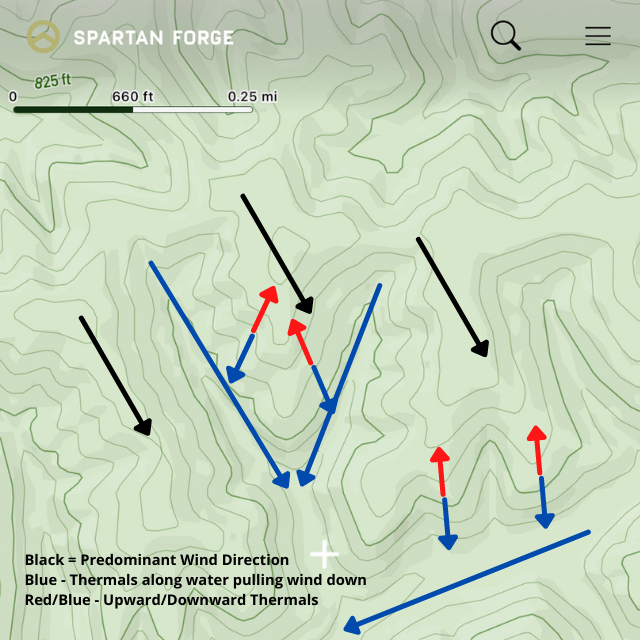
Smart hunters don’t just check wind—they map it. Wind mapping reveals how terrain alters airflow, exposing hidden hunting opportunities.
Start in Open Areas
Begin in a clearing to establish the true prevailing wind using powder, milkweed, or an app.
- This is your baseline.
- All local readings will be compared to it.
Test Each Stand Location
Visit every potential stand or blind site and release milkweed or puff powder.
- Compare local wind to the prevailing direction.
- Note any reversals, swirls, or stagnation.
Identify Terrain-Driven Reversals
Certain features cause wind to reverse or swirl:
- Ridges: Create eddies on leeward sides.
- Drainages and valleys: Often reverse wind flow like river eddies.
- Bluffs and steep slopes: Force air to shift 180 degrees.
- Creek bottoms: Prone to unpredictable currents.
“Think of it like an eddy in a river. The wind flows one way, but hits a ridge and swirls back.” – Article 1
Example:
A southwest wind may blow north in a narrow east-west drainage—perfect for setting up downwind of deer trails.
Record Wind Speed and Temperature
Some reversals only occur under specific conditions:
- Too little wind (<3 mph): No reversal.
- Moderate wind (5–10 mph): Predictable eddies.
- High wind (>15 mph): Swirling, chaotic flow.
Air temperature affects thermal development—especially on sunny mornings.
Note Directions with Compass
Use a compass or GPS to record exact wind angles at each site.
- Mark optimal wind directions when hanging stands.
- Helps you decide which stand to use each day.
“Taking a moment to determine the optimum wind directions for a stand as I hang it saves me time and disturbance.” – Article 3
Understand Thermals and Air Currents
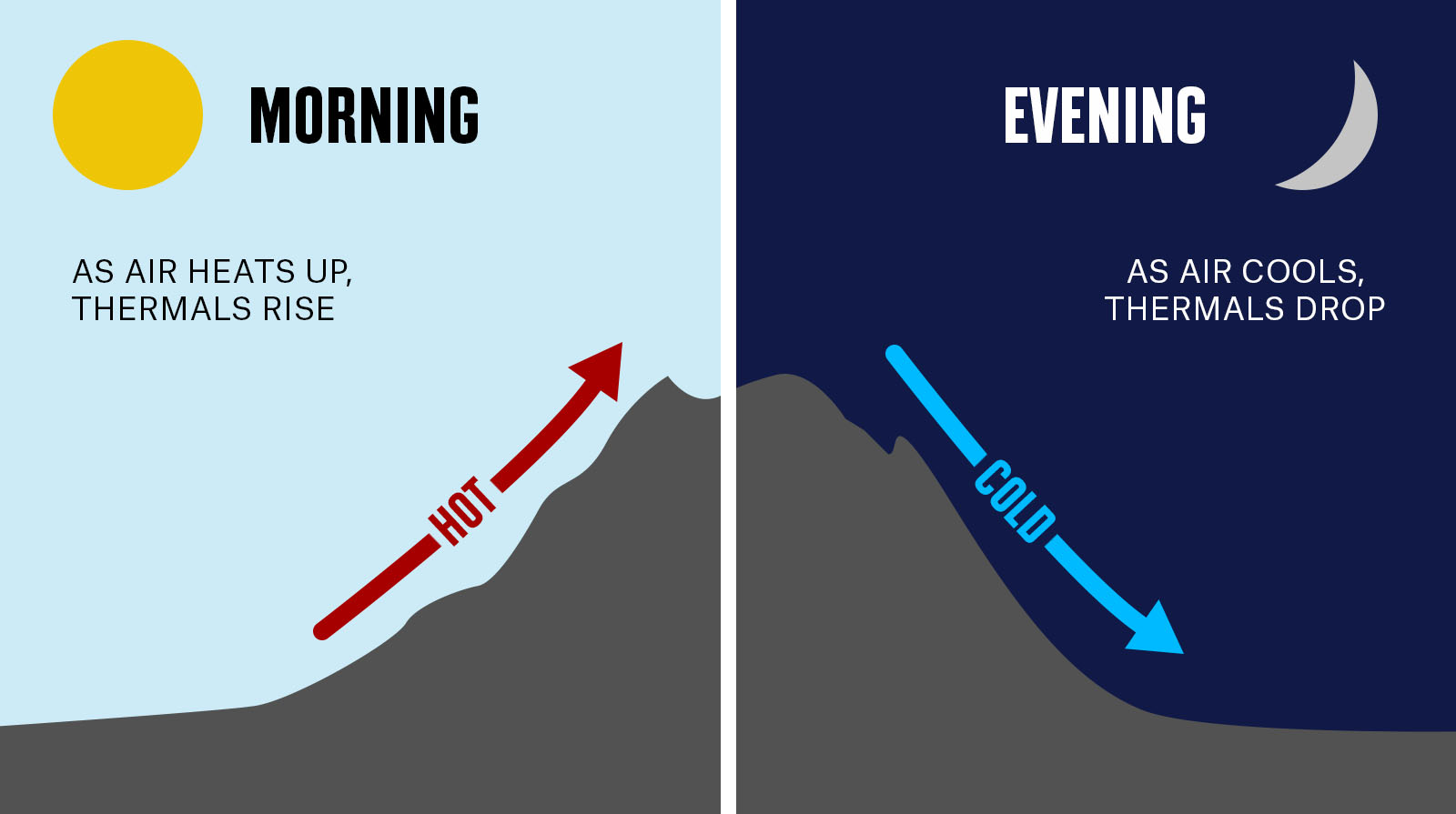
In hilly or mountainous terrain, thermals—rising and sinking air—often overpower prevailing wind.
Morning Thermals Rise
As the sun warms the ground, air heats and rises uphill.
- Set up above deer bedding areas.
- Your scent rises with the air, away from approaching game.
- Most active between 9 AM and 11 AM.
“In the morning, the air temperature warms and rises, so you want to be set up above the deer.” – DwayneEnsign
Evening Thermals Sink
After sunset, cool air becomes dense and flows downhill.
- Position yourself below expected deer movement.
- Scent sinks with the air, staying below animal paths.
- Begins 1–2 hours before sunset.
“In the afternoon, the air cools and sinks, so you will want to set up lower than the deer.” – DwayneEnsign
Time Your Hunts Around Thermal Shifts
In deep valleys, thermals switch direction midday:
- Early morning: Down-valley flow.
- Mid-morning (9–11 AM): Switches to up-valley.
- Late afternoon: Reverses again.
This creates short, predictable hunting windows—often 1–4 hours—before scent control fails.
“This generally meant a quality one to four-hour hunt could be had before the wind switched.” – Article 3
Pro Tip:
- Sunny days accelerate thermal shifts.
- Cloudy or overcast conditions delay or suppress them.
- Always verify with real-time checks.
Know How Terrain Alters Wind
Forecasted wind direction rarely tells the full story. Local topography can flip, funnel, or block airflow.
Ridge Tops: Most Reliable
- Experience stronger, steadier winds.
- Less prone to swirling.
- Easier to predict scent drift.
Ideal for high-confidence setups when wind matches entry route.
Valleys and Creek Bottoms: Risky Zones
- Air stagnates or swirls unpredictably.
- Scent can pool or reverse direction.
- High risk unless thermal patterns are well known.
“Valley bottoms are great places to find deer crossings… but the challenge is finding a spot or time of day when the air currents aren’t swirling.” – Article 3
Finger Ridges and Spurs
Small ridges projecting from larger hills can create wind eddies.
- Wind reverses on the backside.
- Creates stealth zones where deer won’t expect scent.
Example: A south wind may blow north in a small drainage—perfect for an ambush.
Bluff Country: Predictable Reversals
Steep bluffs force wind to compress and reverse.
- Learn these patterns and exploit them.
- Often create consistent downwind funnels.
“On the ridge top, wind blows southwest. But in a small drainage, it reverses and blows straight north.” – Article 1
Choose the Best Wind Conditions
Not all wind is equal. Speed and consistency matter as much as direction.
| Wind Speed | Effect |
|---|---|
| 1–3 mph | Scent lingers; high detection risk. |
| 5–10 mph | Scent carries but disperses; manageable. |
| 10–15+ mph | Carries scent away quickly—ideal if direction is steady. |
“The best situation is when the wind is blowing at greater than 10–15 mph in a constant direction.” – DwayneEnsign
Avoid:
– Calm conditions: Scent pools and drifts unpredictably.
– Gusts or shifting winds: Impossible to track.
– Variable thermals: Especially dangerous in valleys.
Build a Wind-Smart Hunting Strategy
Success comes from preparation, adaptability, and attention to detail.
Hang Multiple Stands
Have stands for different wind directions and thermal patterns.
- Prevents being locked out by bad wind.
- Reduces pressure on any single location.
- Increases hunting opportunities.
For public land or budget hunters:
– Use climbing stands.
– Pre-select 3–5 quality trees.
– Trim lanes in advance for quick, quiet setup.
Scout Off-Season with Smoke
Test suspected eddy zones using smoke bombs (only when fire danger is low).
- Visualize large-scale scent flow.
- Confirm reversal zones.
- Document findings for future hunts.
“Scout in advance: Use off-season time to test wind flow at potential stand sites.” – Article 6
Eliminate Human Scent
Even perfect wind management fails with strong odor.
- Use scent-eliminating soap and sprays.
- Wear carbon-lined clothing.
- Store gear in airtight containers.
- Avoid smoking, cologne, or scented laundry.
“I eliminate my scent as much as possible, because I never know which way the deer will come from.” – 25ft-up
Stay Adaptable in the Field
If real-time wind doesn’t match the forecast:
– Switch stands.
– Use backup locations.
– Monitor wind every 15–20 minutes with milkweed or yarn.
“The key to successful wind management lies in real-time observation and adaptability.” – Article 6
Mastering wind direction combines science and instinct. Use apps to plan, but trust field-tested observations. Study your property’s terrain, learn its thermal rhythms, and always verify with real-time checks. Over time, you’ll turn wind from a threat into your greatest ally—keeping you unseen, unheard, and undetected until the moment matters most.

0 Comments