You’ve seen it in movies—knives spinning through the air, striking the bullseye with a satisfying thunk. But when you try it yourself, the blade wobbles, bounces off, or lands handle-first. If you’re wondering how to throw a hunting knife effectively, here’s the truth: most hunting knives aren’t designed for throwing. Throwing them is risky, inaccurate, and can damage the tool—or worse, cause injury.
The real answer lies in using a purpose-built throwing knife and mastering the techniques used by professionals. This guide cuts through the confusion and delivers a proven, step-by-step method for safe and accurate knife throwing—whether you’re a beginner or refining your skills. You’ll learn why most hunting knives fail in flight, what to use instead, how to grip, stance, release, and adjust for perfect rotation. Plus, we’ll cover essential safety rules, target setup, and progression drills used in competitive throwing. By the end, you’ll know exactly how to throw a knife with precision—no guesswork, no wasted throws.
Choose the Right Throwing Knife

Why Hunting Knives Fail in Flight
Hunting knives are built for skinning, cutting, and field dressing—not flight. Their weight distribution is blade-heavy, causing erratic rotation. The handle design often includes textured grips or guards that disrupt balance. And the steel hardness may be too high (over 55 HRC), making the tip prone to chipping on impact.
Throwing a hunting knife leads to:
– Unpredictable spin
– Frequent bounces
– Bent or broken tips
– Increased safety risks
✅ Bottom Line: Use only knives engineered for throwing.
Key Features of a Throwing Knife
| Feature | Ideal Spec |
|---|---|
| Weight | 200g+ (7 oz) for no-spin; 150–200g for spin |
| Length | 25 cm (10″) or longer |
| Blade Thickness | 5–8 mm |
| Hardness (HRC) | 45–50 — durable but not brittle |
| Construction | Full-tang, one-piece design |
| Balance | Center-balanced or forward-weighted |
| Point | Sharp tip, dull edges |
Knives meeting these specs—like the Smith & Wesson Throwing Knife Set, Cold Steel Sure-Balance, or Acejet Stinger—fly straight and stick reliably.
Best Knives for Beginners
- Smith & Wesson Set (~180g, 10″) – Affordable, durable, ideal starter
- Cold Steel Sure-Balance (~220g, 11.5″) – Balanced, consistent flight
- Gil Hibben Models – Trusted by instructors
- Acejet Stinger (200g+, 8 mm steel) – Pro-grade for no-spin throws
❌ Avoid: Kitchen knives, folding knives, or cheap imports—they’re unbalanced and unsafe.
Build a Safe, Effective Target
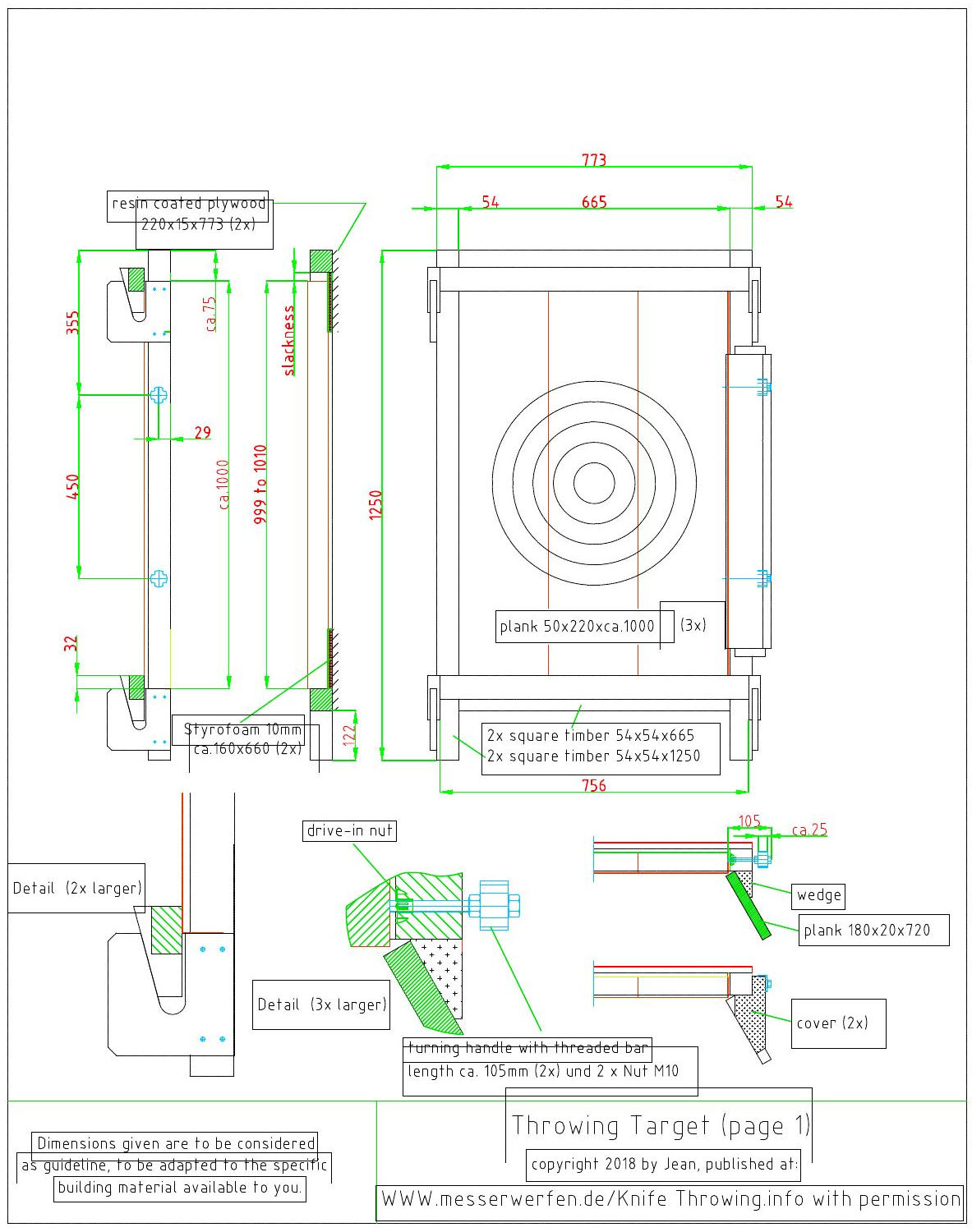
Use Softwood, Not Plywood or Oak
The best target material is softwood: pine, spruce, linden, or birch. These woods allow the knife to penetrate cleanly without excessive bounce.
Avoid:
– Plywood – Glue layers deflect blades unpredictably
– Oak or maple – Too hard; risks tip damage
– Live trees – Dense grain increases breakage risk
Set Up the Target Correctly
- Thickness: 50–75 mm (2–3 inches)
- Size: At least 3×3 feet (90×90 cm)
- Height: Shoulder-level (~1.5 m / 5 ft)
- Backstop: 6–10 feet clearance behind target
🔁 Replace target when deeply pitted—cracks and holes cause dangerous ricochets.
DIY vs. Commercial Options
- DIY: Use scrap 2×6 pine boards. Cost: under $10.
- Commercial: Pre-built targets with bullseyes and frames—ideal for consistency.
Follow Strict Safety Rules
Never Throw in Unsafe Areas
- Only throw in dedicated, isolated spaces (backyard, shed, range).
- Mark a clear throwing line.
- Ensure no one is near the target during throws.
- Wear sturdy footwear—never sandals.
⚠️ Never catch a returning knife. As the saying goes: “A returning knife has no handle.”
Indoor Practice Tips
- Use carpeted rooms to minimize bounce.
- Lower the target height.
- Practice no-spin throws at 1 meter to build control.
Legal and Environmental Awareness
- Check local laws—some areas ban knife throwing in residential zones.
- Post warning signs if others share the space.
- Keep a first aid kit nearby.
Master the Full-Spin Throw
When to Use Full-Spin Technique
The full-spin throw is the best starting point for beginners. The knife completes one full 360° rotation over 10 feet (3 m). In competition (WKTL), two rotations are used at 15 feet (4.5 m).
Step-by-Step Execution
- Stance:
– Feet shoulder-width or staggered (dominant foot forward).
– Shoulders square to target. - Grip:
– Hammer grip—full hand on handle, thumb on spine. - Motion:
– Raise arm beside head, elbow tucked (“elbow to ear”).
– Keep wrist locked. - Release:
– At eyebrow level, during peak forward swing.
– Let knife slide out—no flicking. - Follow-through:
– Point index finger at target or bring hand to pocket.
Fix Rotation Errors Fast
- Handle hits first (under-rotation) → Step back 6–12 inches
- Tip hits first (over-rotation) → Step forward
- Small distance changes make big differences.
🎯 Pro Tip: In WKTL, competitors fine-tune their sweet spot within ±6 inches—find yours through repetition.
Learn the Half-Spin Throw
Short-Range Accuracy at 5–7 Feet
The half-spin throw covers 180° rotation and is ideal for close distances (1.5–2.1 m). It’s highly accurate but requires blade control.
How to Perform It
- Grip:
– Pinch grip—blade between thumb and index finger.
– Handle points up. - Stance:
– Slight angle, relaxed posture. - Motion:
– Smooth forward swing with slight wrist twist. - Release:
– Mid-swing, controlled—no snap.
⚠️ Warning: Holding the blade increases cut risk. Keep grip firm and hands dry.
Master the No-Spin Throw
Advanced Precision Without Rotation
The no-spin throw keeps the knife stable in flight—no rotation. It’s used by world champions for accuracy at 1–7 meters (3–23 ft).
Slider Grip Technique
- Grip:
– Index finger on blade spine, just behind balance point.
– Thumb on side, other fingers wrapped. - Stance:
– Slight angle, relaxed. - Motion:
– Pull arm back like a bow.
– Keep wrist rigid. - Release:
– Push forward, maintain pressure until knife exits.
– Listen for a light drag sound—indicates clean release.
Adjust Release by Distance
| Distance | Index Finger Position |
|---|---|
| 1–2 m | Just behind balance point |
| 3 m | Slightly higher on blade |
| 6–7 m | Near handle for max leverage |
Step-Back Drill for Progression
- Start at 1 meter—focus on sticking.
- Move back 20–30 cm after 10 consistent sticks.
- Stop when accuracy drops.
- Return to last good distance and repeat.
🌟 Elite Tip: No-spin throws eliminate distance guesswork once mastered.
Fix Common Throwing Mistakes

Overcome Poor Technique Fast
| Mistake | Symptom | Fix |
|---|---|---|
| Too much force | Bounces, erratic flight | Focus on smooth release |
| Wrist flicking | Over-rotation | Lock wrist, use arm only |
| Early/late release | High/low hits | Release at eyebrow level |
| Inconsistent grip | Unpredictable throws | Mark grip with tape |
| Rushing progression | Frustration, bad form | Master 1-meter throws first |
Use the Theory of Rotation
“More contact = slower spin. Less contact = faster spin.”
- Over-rotation? Add thumb to spine or use full grip.
- Under-rotation? Lift pinky, remove thumb, or use fingertip grip.
This lets you correct spin without changing distance.
Perfect Your Stance and Posture
Choose a Stable Stance
- Staggered: Dominant foot forward—most stable.
- Parallel: Feet shoulder-width, angled—good for follow-through.
- Dart-like: Square to target—mimics darts players.
✅ Key: Consistency matters more than form.
Optimize Body Mechanics
- Shoulders square to target—ensures straight flight.
- Elbow to ear—keeps path aligned.
- Relax—tension kills fluidity.
- Optional: Step into throw for added momentum.
Progress Through Structured Practice
Beginner Practice Checklist
✅ Use a throwing-specific knife
✅ Build softwood target
✅ Clear safety zone
✅ Start at 6–10 feet
✅ Use hammer grip for full-spin
✅ Focus on smooth release and distance
✅ Practice 2–3 times per week
📈 “Success isn’t strength—it’s precision, consistency, and control.” – Adam Čeladín
Training Plan for No-Spin Mastery
- Ground throws – Build confidence
- Low target (1 m high) – Improve accuracy
- Increase height gradually – Simulate real conditions
- Extend distance – Use step-back drill
- Adjust release point – Learn grip-to-distance relationship
Track and Improve Performance
- Record video of throws to analyze:
- Wrist position
- Release timing
- Follow-through
- Keep a practice log:
- Distance
- Stick rate
- Grip type
- Adjustments made
Compete and Refine Your Skill
Train Like a WKTL Competitor
- Competition distances:
- 10 ft – 1 full rotation
- 15 ft – 2 full rotations
- Allowed techniques: Full-spin, half-spin, no-spin.
- Knives must meet safety standards.
Prepare for Competition
- Practice at exact distances.
- Master one or two techniques.
- Focus on repeatability, not showy throws.
- Join a local throwing group for feedback.
🎯 Note: Multi-spin throws are for show—two rotations max in scoring.
Maintain Equipment and Mindset
Keep Knives in Top Condition
- Inspect for:
- Tip damage
- Blade warping
- Handle wear
- Sharpen tips for better sticking.
- Store in protective sheath or pouch.
Develop the Right Mindset
- Be patient—mastery takes hundreds of hours.
- Enjoy the process—progress comes from repetition.
- Focus on form, not instant results.
- Treat it like darts or archery—a precision sport, not combat.
Long-Term Growth Tips
- Stick to one knife to build muscle memory.
- Join a knife-throwing community.
- Attend workshops or ranges—many axe-throwing venues allow knives (call first).
You now have a complete, field-tested system for throwing a knife safely and accurately. Forget the myth of using a hunting knife—focus on the right tool, proper technique, and disciplined practice. Whether you’re throwing for fun, fitness, or competition, the path to mastery starts with a single, well-executed throw. Stay safe, stay consistent, and let every stick build your confidence.

0 Comments