Spring stirs something deep in the soul of every forager—the scent of damp earth, the whisper of new leaves, and the quiet promise of morels hiding beneath the leaf litter. But if you’re wandering the woods with no plan, your basket will likely stay empty. The truth is, morel hunting tips that work aren’t about luck—they’re about strategy. With the right timing, knowledge of host trees, and smart field tactics, you can turn a fruitless trek into a bountiful harvest.
Forget random walks through the forest. The real secret? Stop hunting mushrooms—start hunting trees. You’ll learn how to track soil temperature, identify high-yield host species, use burn maps, and harvest sustainably. Whether you’re a beginner or a seasoned forager, these proven morel hunting tips will transform your approach—and your yield.
Decode Soil & Weather Clues Like a Pro

Timing is everything. Morels won’t appear just because it’s April. They respond to precise environmental triggers. Show up too early, and you’ll find nothing. Wait too long, and they’ll be dried out or picked clean. The key lies in the ground—not the calendar.
Hit the 50°F Soil Threshold
The single most reliable sign that morels are on the way is soil temperature reaching 50°F (10°C). This isn’t a one-day spike—it needs to be sustained. Aim for at least 7 consecutive days of nighttime soil temps at or above this mark. Use a handheld soil thermometer or check real-time data at Greencast Soil Temperature Tool. Test under leaf litter on south-facing slopes, which warm first and often yield the earliest morels.
Pro Tip: Morels thrive between 50°F and 60°F. Once soil climbs above 60°F, the season typically winds down fast.
Watch Air Temperature & Rainfall Patterns
While soil temp is king, air conditions fine-tune the hunt:
– Night lows should stay above 40°F–50°F.
– Daytime highs between 70°F–80°F are ideal.
– A good rain event followed by warming days often triggers fruiting.
– High humidity keeps morels plump and growing.
Avoid hunting if temps exceed 85°F–90°F—morels dry out quickly, and the season can end in just one hot day.
Warning: A forecasted 90°F day is your cue to harvest immediately.
Use Nature’s Calendar: Phenology Signs
Local plant behavior gives real-time clues:
– Dandelions: When they bloom → get ready. When they go to seed → hunt aggressively.
– Oak leaves: When new leaves are the size of a mouse’s ear, morels are likely up.
– Tulip poplar, ash, and elm: Watch their leaf-out stages—these trees host morels and signal regional timing.
Example: In South Dakota, morels often appear about 10 days after dandelions bloom.
Target the Right Trees & Habitats

You won’t find morels in just any forest. They grow in specific ecological niches tied to certain trees, soil types, and disturbance patterns. Hunt trees—not mushrooms.
Focus on Key Host Trees
Morels associate with specific trees. Know them, and you’ll know where to look.
| Tree | Why It Matters |
|---|---|
| Elm (especially dying ones) | One of the most reliable hosts. Look for skeletal trees with bark still clinging. |
| Ash (declining or dead) | Produces strong yields, especially in Midwest forests. |
| Tulip Poplar | Common in eastern U.S.; watch lower trunks and root zones. |
| Apple & Pear | Found near old orchards, homesteads, and fencerows. |
| Sycamore & Cottonwood | Prefer moist bottomlands and riverbanks. |
| Aspen & Ponderosa Pine | Western species; often post-fire. |
| Madrone | Strong indicator in Pacific Northwest and California. |
Expert Note: Morels grow within 10–30 feet of the trunk. Focus your search here first.
Hunt Burn Zones & Disturbed Ground
Some of the best patches appear after fire or human activity.
Fire-Affected Areas
- Wildfires or controlled burns boost morel production the following spring.
- Species like Morchella sextelata and M. tomentosa thrive in fully burned conifer zones.
- Use the Midwest NR Fire Map to locate recent burns.
- Patches can return for 2–5 years after a fire, especially with good rainfall.
Disturbed Sites
- Old homesteads, gardens, roadsides, and construction zones often host M. rufobrunnea (blushing morel).
- Nitrogen-rich, compacted soils create ideal conditions.
- Riverbanks and floodplains also support dense growth.
Optimize by Slope & Aspect
Sun exposure affects soil warmth and timing:
– Early season: Search south- and west-facing slopes—they warm first.
– Late season: Shift to north- and east-facing slopes and shaded benches.
– Look under downed timber, root balls, and leaf mounds—these retain moisture and heat.
Pro Tip: Use Google Earth to scout tree lines, burn scars, and slope aspects before you go.
Master the Search: Field Strategies That Work
Even with perfect timing and location, poor technique leads to empty baskets. Success comes from pattern recognition, movement, and awareness.
Scout Before the Season
- Walk sites in winter when trees are bare.
- Look for dead or dying elms, ashes, and apples.
- Mark GPS coordinates or use apps like HuntWise, OnX, or Gaia GPS.
- Study topography: look for drainage patterns, flood zones, and burn history.
Mistake to Avoid: Waiting until spring to find spots. Top hunters plan months ahead.
Use the “Look Up, Then Down” Method
- Start high: Spot host trees from a distance.
- Then scan low: Focus within 10–15 feet of the trunk (up to 30 feet on slopes).
- Move slowly and scan leaf litter, not just bare soil.
- Use a walking stick to gently lift vegetation and reveal hidden morels.
Freeze When You Find One
- Stop immediately when you spot a morel.
- Scan the 3–10 foot radius—they grow in patches.
- Look under leaves, near stumps, and under logs.
- Mark the spot mentally or with GPS for future visits.
Pro Tip: Take photos of the tree, soil, and surrounding area to build a mental habitat model.
Hunt Smart: Timing & Competition
- Best day to hunt public land: Thursday—after weekend pickers leave, before Saturday crowds arrive.
- Private land advantage: Return every few days to let small morels mature.
- Follow the 80/20 rule: 80% of morels grow in 20% of the land. Focus on high-probability zones.
Use Real-Time Sighting Maps
- Check The Great Morel – Morel Sightings Map for regional updates.
- See where others are finding morels—and adjust your plans.
Gear Up for Safety & Success
The right tools make hunting safer, more efficient, and more productive.
Wear Protective Clothing
- Long sleeves and pants protect against poison ivy, thorns, and insects.
- Camo or earth tones help avoid attention near roads.
- Choose brush-resistant fabric for dense woods.
Prevent Tick & Insect Bites
- Pre-treat clothes with permethrin the night before.
- Carry aerosol mosquito spray.
- Do a full tick check after every hunt.
Essential Tools
- Mesh bags or onion sacks: Allow spores to drop as you walk.
- Mushroom knife (e.g., Opinel No. 8): Sharp, curved blade + built-in brush.
- Walking stick: Move brush and maintain balance on slopes.
- Field bag: Carry water, snacks, knife, and guidebook.
Safety First: Watch for snakes (especially copperheads) under logs and in brush.
Identify True vs. False Morels
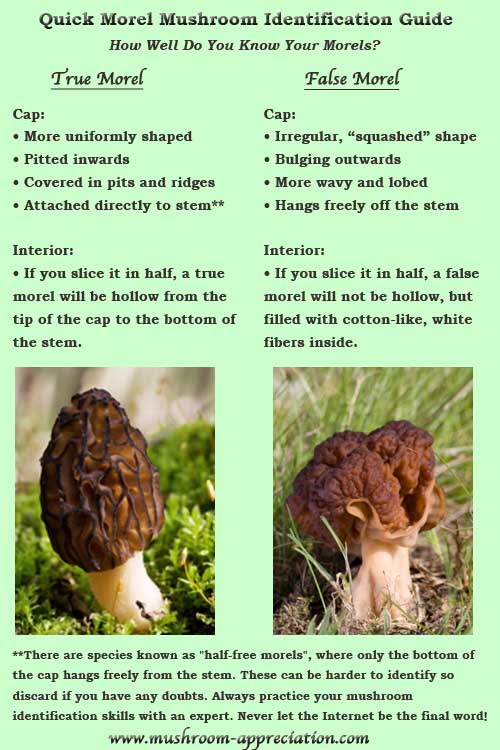
Misidentification can be dangerous. Know the difference.
True Morels (Morchella spp.)
✅ Hollow throughout—from cap tip to stem base
✅ Cap fully attached to the stem
✅ Honeycombed surface with pits and ridges
✅ Safe to eat when cooked
False Morels (Toxic)
❌ Gyromitra spp. (“brain mushrooms”):
– Cap is wrinkled, not pitted
– Interior is cottony or chambered, not hollow
– Contains gyromitrin, a toxin linked to liver damage
– Not safe—avoid entirely
❌ Verpa spp. (“early morels”):
– Cap hangs free from the stem (only attached at top)
– Interior often fibrous, not hollow
– Edible when thoroughly cooked, but risky for beginners
Golden Rule: “When in doubt, leave it out.”
Harvest Like a Pro: Sustainably & Effectively
How you pick affects future crops and mushroom quality.
Cut or Pinch at Ground Level
- Use fingers or a knife to sever the stem cleanly.
- Leave the volva (base) in the soil to protect the mycelium.
- Never pull—this can damage the underground network.
Clean in the Field
- Use the boar’s hair brush on your mushroom knife.
- Remove dirt, ants, and leaf debris before bagging.
Should You Leave Small Morels?
- Most don’t grow much larger after 3 days.
- Many dry out or degrade quickly.
- If the stem is firm and cap open, it’s likely mature.
- Harvest at peak freshness unless conserving a rare patch.
Spread Spores as You Go
- Use mesh bags—spores fall through as you walk.
- Helps regenerate future crops.
Clean, Cook & Preserve Like a Chef
Morels are culinary gold—but require proper prep.
Clean Without Sogginess
- Quick rinse if from clean soil.
- Saltwater soak (2–4 hours) for bug removal—especially in warm weather.
- Never soak in plain water—they absorb moisture and turn mushy.
- Dry on a rack or paper bag—never seal in plastic.
Pro Tip: Slice large morels lengthwise to check for bugs inside.
Always Cook Thoroughly
- Raw morels can cause stomach upset.
- Sauté in butter and garlic—classic and delicious.
- Deep-fry battered, grill halved, or add to risotto and omelets.
- Pair with wild game, steak, or creamy sauces.
Store for Long-Term Use
- Fresh: Eat within 24 hours. Store in a paper bag in the fridge (up to 7 days).
- Drying: Use a dehydrator at 110°F for 8–10 hours, or oven on lowest setting.
- Store dried in Mason jars with screw-top lids.
- Rehydrate in warm water (20 minutes) before cooking.
- Freeze only after drying—vacuum seal for up to 1 year.
Note: Dried morels keep flavor but lose texture.
Sell or Share: Know the Value
Morels are a valuable wild commodity—especially in low-yield years.
Market Prices (2024)
- $15–$30 per pound, depending on region and quality.
- Premium prices for early/late season, clean, large specimens.
- Lower prices for sandy, muddy, or damaged morels.
Where to Sell
- Farmers markets: Highest returns—direct to chefs and foodies.
- Online: Facebook, Craigslist—advertise locally.
- Commercial dealers: Bulk buyers; moderate prices.
- Restaurants: Often pay less but buy in volume.
Pro Tip: Some foragers drive across state lines for better rates.
Legal & Ethical Rules
- Check local laws: Some states ban selling mushrooms from public lands.
- Get permits if foraging commercially.
- Respect private property—ask permission.
- Leave no trace—don’t overharvest or damage habitats.
Think Like a Morel: Ecology Matters
Understanding biology makes you a better hunter.
Mycorrhizal vs. Saprotrophic
- Most morels form symbiotic bonds with tree roots (mycorrhizal)—they trade nutrients for sugars.
- Others feed on dead wood and organic matter (saprotrophic), especially after fires.
Spore Dispersal & Patch Growth
- Morels spread via microscopic spores.
- One mushroom often means siblings nearby.
- Patches return annually if conditions stay favorable.
Key Insight: The mushroom is just the fruit. The real network—the mycelium—lives underground year-round.
Final Note: The best morel hunting tips all point to one truth: stop hunting mushrooms—start hunting trees. Success comes from preparation, pattern recognition, and respect for nature. Whether you’re filling a basket for dinner or a bag for profit, the forest rewards those who observe, adapt, and return. Now go find them.

0 Comments