Picking the right camouflage isn’t about fashion—it’s about function. In the wild, a single misstep in pattern choice can turn a promising hunt into a missed opportunity. Animals detect unnatural shapes, movement, and contrast long before they notice color. That’s why understanding the types of camouflage patterns for hunting is essential for staying unseen. From dense hardwood forests to snow-covered alpine ridges, each environment demands a specific approach to concealment.
Modern hunting camo has evolved far beyond basic green and brown blobs. Today’s patterns are engineered using animal vision science, digital imaging, and terrain-specific data to disrupt silhouettes, blend textures, and match real-world backdrops at multiple distances. Whether you’re tracking mule deer across open sagebrush or waiting for a flock of geese to drop into a marsh, your success hinges on how well your gear disappears into the landscape.
This guide breaks down every major type of hunting camouflage—from classic splotch designs to cutting-edge abstract systems—matching them to terrain, species, and hunting style. You’ll learn how deer, turkeys, and waterfowl perceive threats, why motion trumps color, and which patterns deliver real results in the field. By the end, you’ll know exactly which camo to wear—and why.
Traditional Splotch Patterns: The Original Disruptors
Before photorealistic prints and digital algorithms, hunters relied on bold, high-contrast splotches to break up their outline. Inspired by military designs like the U.S. M81 Woodland, these patterns use large, irregular shapes in green, brown, tan, and black to mimic shadows and foliage masses.
Why Splotch Patterns Still Work
These designs don’t replicate specific plants—they disrupt the human form. Even without fine detail, they create visual confusion by fragmenting the body’s silhouette, making it harder for animals to recognize a threat.
Top Traditional Patterns
- Realtree Original: A versatile staple for mixed hardwoods and brushy terrain
- Mossy Oak Bottomland: Effective in dense timber and swampy areas
- Heritage Duck: Despite its name, works well in general woodland zones
- Buffalo Check (Plaid): Not true camo, but historically used because red-black appears gray to deer while remaining visible to other hunters
Pro Tip: Splotch patterns excel in close-range hunting where movement control is critical. They’re less detailed than modern leafy camos but remain effective across varied environments.
Avoid fixating on exact color matches. Instead, focus on silhouette disruption—even a simple splotch pattern can hide your shape when paired with stillness and natural cover.
Leaves and Limbs: 3D Photorealistic Camouflage

Also known as leafy, stick-and-leaf, or mimetic camo, this is the most widely used type today. It uses high-resolution digital prints of real leaves, bark, branches, and shadows to create depth and realism.
How It Tricks Animal Vision
Animals detect unnatural shapes and outlines. This camo mimics actual forest elements, making it harder for game to recognize a human form—even when partially exposed. The layered textures and micro-details help break up edges, especially in complex environments.
Best Patterns by Habitat
- Mossy Oak Brush: Ideal for open woods, agricultural edges, and dry fields
- Realtree Edge: Designed to hide the body’s outline at both long and close range
- Mossy Oak Rio: Blends woods and open country—great for deer and dove
- Realtree Timber: Realistic tree bark texture—perfect for tree stands
- Mossy Oak Shadow Grass Habitat: Waterfowl-specific with cattails and reeds
- Realtree Max-7: High-contrast marsh camo for ducks and geese
Expert Note: These patterns are especially effective for turkey and waterfowl hunting, where sharp eyesight and pattern recognition make detection fast.
Use photorealistic camo in visually rich environments like hardwood forests, wetlands, or crop fields. The more complex the background, the better this type performs.
Abstract & Digital Camouflage: Science Over Realism
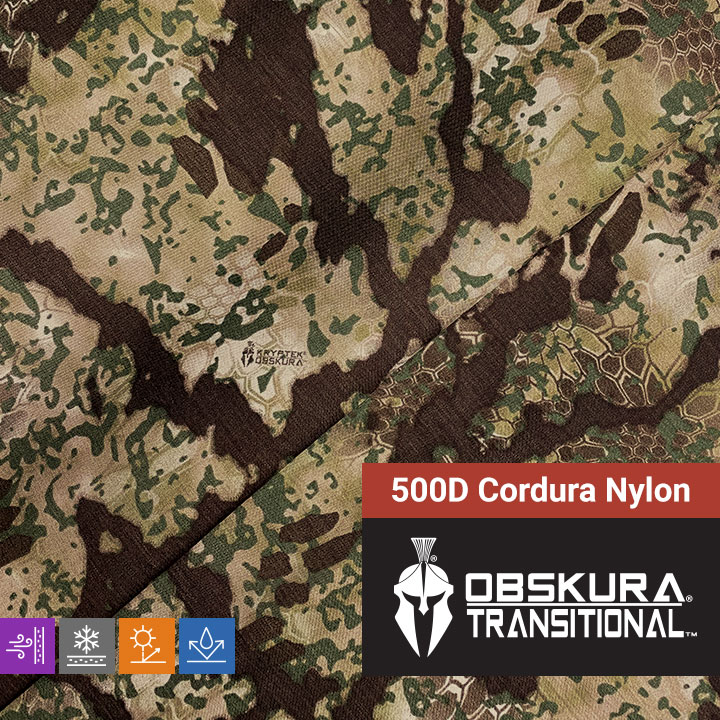
Unlike leafy patterns, abstract camo doesn’t try to look like real plants. Instead, it uses non-representational shapes, pixelation, or mathematically engineered designs to confuse visual perception.
Core Advantages
- Breaks up the human form using micro and macro patterns
- Works across distances—effective even during movement
- Based on studies of how animals process visual input
Leading Abstract Patterns
- Veil Flagship / Flagship X: Engineered using vision science; creates “chaos control” in natural settings
- Kryptek Obskura Transition: Tested by U.S. government; works across 70% of Earth’s surface
- Under Armour Forest 2.0: Brush-stroke abstract; optimized for performance gear
- Multicam: Military-originated; blends greens, tans, and grays for multi-environment use
- Mossy Oak Elements Terra: Earth-toned abstract with green accents to simulate moss and lichen
Pro Tip: Abstract patterns shine in open terrain—like deserts, tundras, or mountain slopes—where there are fewer leaves and more rock, sand, or snow.
They’re also ideal for long-range stalking, especially for elk, mule deer, or predators where you need concealment at distance.
Match Camo to Your Hunting Environment
Woodland Forests: Eastern & Mixed Hardwoods
In shaded, layered forests, your camo must handle canopy cover, underbrush, and dappled light.
Best Choices
- Mossy Oak Brush
- Realtree Edge
- Mossy Oak Country DNA
- Hillman 3DX (ultra-realistic 3D depth)
- M81 Woodland (budget-friendly surplus option)
Key Features to Look For
- High contrast between darks and lights
- Realistic leaf and bark textures
- Micro-detail for close-range concealment
Visual Cue: Stand 20 yards away from a mirror or vehicle wearing your gear. If your shape is still obvious, the pattern isn’t breaking you up enough.
Perfect for whitetail deer, bear, and turkey in regions like the Appalachians or Pacific Northwest.
Waterfowl Wetlands: Marshes & Flooded Timber
Ducks and geese see from above and have tetrachromatic vision—they detect UV light and subtle color differences invisible to humans.
Critical Rules
- Avoid UV brighteners in detergents
- Wear full-face masks and gloves
- Choose patterns with vertical reeds, cattails, and water reflections
Top Waterfowl Camos
- Realtree Max-7: High-contrast marsh design; mimics flooded timber
- Mossy Oak Shadow Grass Habitat: Digitally accurate wetland vegetation
- GORE™ Optifade™ Marsh: Scientifically tuned to duck vision
- FORLOH Deep Cover Camo: Realistic grass and stubble blending
Expert Note: Since waterfowl approach from the sky, your entire silhouette—including waders and layout boat—must match the surroundings.
Use in southern swamps, prairie potholes, or cut cornfields where geese feed.
Desert & Arid Zones: Southwest & Open Flats
Tan, gray, and light brown dominate here. Green is minimal, so traditional woodland camo stands out.
Best Options
- Kryptek Typhon: Designed for dry, rocky terrain
- Multicam Desert variant: Seven-color blend for shifting light
- FORLOH Exposed Camo: Neutral tones for sagebrush and sand
- U.S. DCU (Desert Camouflage Uniform): Surplus option for budget hunters
Why Abstract Wins
Open country lacks dense foliage. Abstract patterns with neutral macros and micro-textures blend better than leafy designs that scream “forest.”
Ideal for mule deer, pronghorn, and bighorn sheep in Arizona, New Mexico, or Nevada.
Snow-Covered Terrain: Winter & Late-Season Hunts

When snow blankets the ground, white becomes your primary concealment tool.
Recommended Patterns
- FORLOH Snowfall Camo: White with subtle gray and brown accents
- Snow Multicam: Includes neutral tones for rocks and dead grass
- Military winter variants (e.g., Flecktarn snow): Durable and proven
Don’t Forget:
- White face masks and gloves
- Camo snow bibs and parkas
- Non-reflective gear (avoid shiny zippers or lenses)
Warning: Pure white alone can look unnatural. The best snow camo includes light gray and faint brown streaks to mimic real winter landscapes.
Use in Alaska, Canada, or high-elevation Rockies for elk, caribou, or late-season deer.
Upland & Open Country: Prairies, Tundra, Fields
These areas have few natural objects to blend with—just open sky and flat terrain.
Camo Strategy
- Prioritize low-visibility neutral tones
- Use blaze orange components for safety (required in many states)
- Consider reversible gear—camo on one side, blaze orange on the other
Top Picks
- Kryptek Highlander: For high-altitude plains
- Multicam: Versatile across grasslands and stubble
- FORLOH Exposed Camo: Minimalist design for open visibility
Fact: Many upland hunters skip full camo because terrain doesn’t support it. But even a camo hat and vest can reduce detection when combined with stillness.
Perfect for pheasant, quail, chucker, and open-field turkey.
Science-Backed Camo: GORE™ Optifade™ and Beyond
GORE™ Optifade™: Engineered for Animal Vision
This isn’t just another pattern—it’s a biologically informed concealment system built using data on how deer, elk, and ungulates see the world.
How It Works
- Mimics predator camouflage (like tiger stripes for motion disruption)
- Uses micro-patterns within macro-patterns to prevent detection
- Accounts for sky-to-ground contrast, especially in treestand hunting
Best Optifade Patterns
- Elevated II: For tree stands; handles bright sky and leafless trees
- Subalpine: For stalking in forested mountains (<50 yards)
- Open Country: Large neutral zones for long-range alpine hunting
- Timber & Marsh: For flooded woods and crop fields
Pro Tip: Optifade Elevated II outperforms traditional camo before and after leaf drop, making it ideal for early and late archery seasons.
If you want the scientific edge, this is the gold standard.
Species-Specific Camo Tips
Deer Hunting
- Use disruptive patterns (leafy or abstract)
- Blaze orange is safe—deer see it as dull yellow
- Focus on head, hands, and movement
Best: Mossy Oak Brush, Realtree Edge, Optifade Elevated II
Turkey Hunting
- Turkeys have excellent color vision and pattern recognition
- Avoid blaze orange—wear full camo head-to-toe
- Use facial veils and glove covers
Best: Realtree Timber, Mossy Oak Bottomland, Veil Flagship
Waterfowl Hunting
- Must avoid UV-reflective materials
- Wear layout blinds with camo nets
- Match exact habitat: marsh, stubble, or flooded timber
Best: Realtree Max-7, Mossy Oak Shadow Grass, Optifade Marsh
Final Decision Guide: Best Camo by Use Case
| Hunting Scenario | Top Camo Patterns |
|---|---|
| Eastern Whitetail | Mossy Oak Brush, Realtree Edge, Hillman 3DX |
| Western Elk/Mule Deer | Kryptek Obskura, Multicam, Optifade Open Country |
| Waterfowl (Marsh) | Realtree Max-7, Mossy Oak Shadow Grass, Optifade Marsh |
| Turkey (Timber) | Realtree Timber, Mossy Oak Bottomland, Veil Flagship |
| Snow Hunts | FORLOH Snowfall, Snow Multicam, white outer layers |
| All-Terrain Flexibility | Multicam, Realtree Advantage Classic, Mossy Oak Country DNA |
| Science-Optimized | GORE Optifade series, Kryptek, Veil Flagship X |
Bottom Line: The best types of camouflage patterns for hunting depend on where you hunt, what you hunt, and how you hunt. No single pattern wins everywhere. But by matching your camo to the environment, understanding animal vision, and maintaining your gear, you dramatically increase your odds of getting close—and staying unseen.
Choose wisely. Move quietly. And let your camo do the talking.
0 Comments