There’s nothing quite like the moment a mature whitetail buck steps into your shooting lane—head up, ears flicking, completely unaware you’re there. For most hunters, that moment is pure magic. But it’s rarely luck. The truth? Consistent success in whitetail hunting comes from mastering the details—wind, timing, stand placement, and mindset. If you’re ready to stop guessing and start tagging mature bucks, these whitetail hunting tips will transform your approach. From pre-season scouting to moon phases and shot placement, we’ll break down what actually works in the field.
Let’s get into the strategies that separate the casual hunter from the consistent killer.
Hunt Downwind—Or Don’t Hunt at All
Deer don’t need to see or hear you to know you’re there. They smell you. A whitetail’s nose is 500 times more sensitive than a human’s. One whiff of coffee, laundry detergent, or even your breath, and your hunt is over.
Always Set Up Downwind of Deer Movement
If deer are bedding to the west and feeding east, hunt east of the bedding area—especially in the Midwest, where prevailing winds come from the west, northwest, and southwest. That way, your scent blows away from them.
Before climbing into your stand:
– Spray boots, clothes, and gear with scent-eliminating spray (like Slay).
– Shower with scent-killing soap the night before.
– Wear unscented deodorant and store clothes in scent-free containers until hunt time.
– Avoid cigarettes, coffee, and gasoline—they leave odor trails deer can’t miss.
“If a person can smell you smoking a cigar, a deer standing in the same spot can smell you.”
While some claim they’ve smoked in the woods with no issues, the overwhelming evidence says otherwise: scent control is non-negotiable if you want to fool mature bucks.
Boost Your Scent Control with Technology
- Use Ozonics units that hang above your stand, breaking down human odor with ozone.
- Apply Evercalm deer-attracting stick around the base of your tree to mask your scent with natural deer aromas.
- Keep your face covered—70% of body heat and odor escapes through your head. Wear a dual-layer facemask: a thin camo one over a Smartwool balaclava for warmth and silence.
Master Thermal Airflow—It Changes Everything
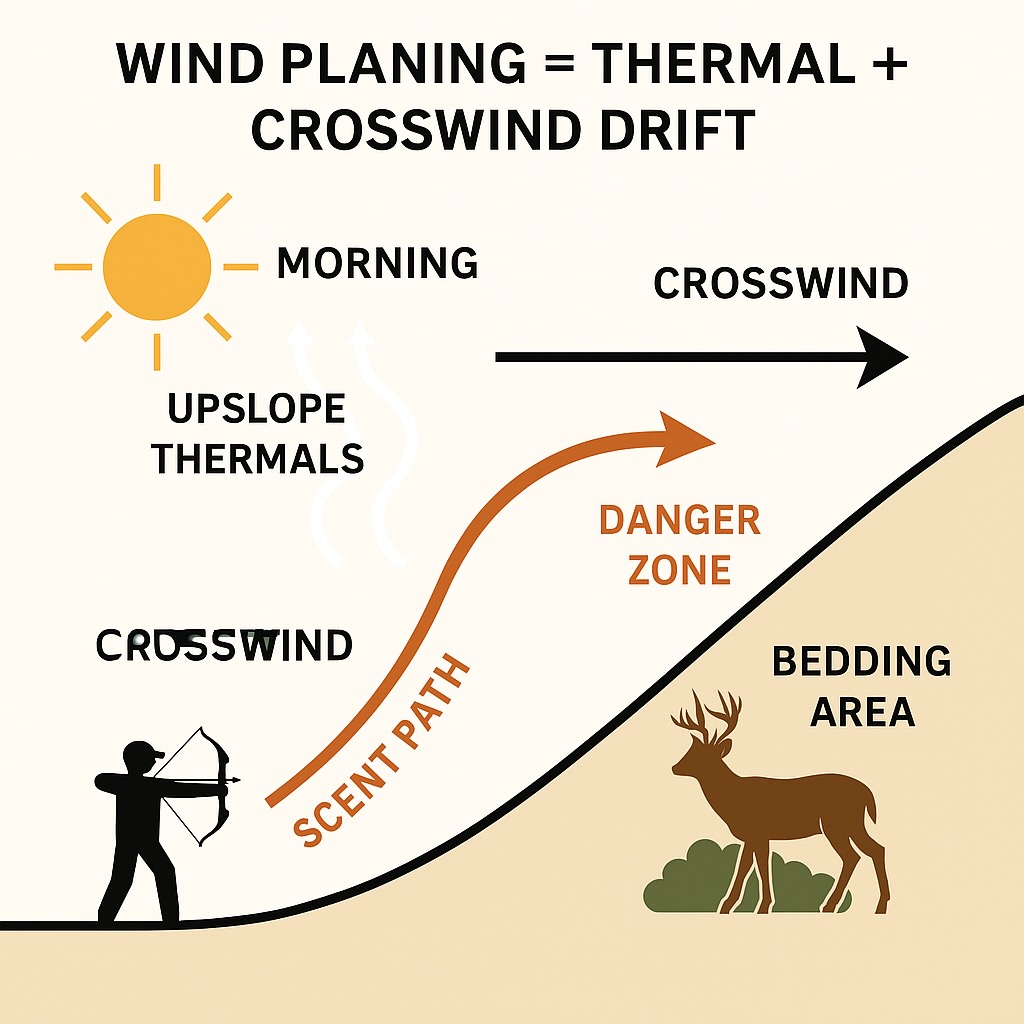
Wind isn’t just horizontal. Thermal currents move up and down slopes, and they can betray your position even if the surface wind seems perfect.
Morning: Hunt High, Let Scent Sink
In the early hours, cold air flows downhill, carrying your scent with it. This makes ridge tops and high benches ideal morning spots—especially if you’re downwind of bedding areas. A buck bedded below won’t catch your scent as it rises with the warming day.
Midday: Avoid the Chaos
By mid-morning, sun-warmed slopes create updrafts, while shaded areas produce downdrafts. This creates unpredictable, swirling air—perfect for getting busted.
Your best bet?
– Hunt in fully shaded or fully sunny zones, where airflow is stable.
– Avoid ridge saddles and transition zones where thermals collide.
Scout Like a Pro—Before the Season Starts
Success begins weeks before opening day. The best hunters know where bucks will be because they’ve already seen them.
Start Scouting 4–6 Weeks Out
Look for:
– Bedding areas: thick cover on north-facing slopes or ridges.
– Feeding zones: soybean fields, corn stubble, food plots.
– Travel corridors: ditches, creek bottoms, fence lines.
– Pinch points: narrow strips where terrain funnels deer.
Signs to watch for:
– Rubs and scrapes (especially in pre-rut).
– Tracks, droppings, and beds.
– Shed antlers (with landowner permission)—high shed density = high buck activity.
Glass After Rain for Better Visibility
Wet conditions make deer easier to spot. Use binoculars to scan summer soybean fields in the late afternoon after a light rain. Big bucks often feed during these low-pressure windows.
Find the “Killing Tree”—Your Secret Weapon

In any 40-acre block, 70–80% of deer pass within range of just 1–2 key trees. These are your killing trees—strategic stand locations at trail intersections, funnels, or pinch points.
What makes a killing tree?
– Located on secondary trails used by mature bucks (often under thicker cover).
– Offers multiple shooting lanes and safe entry/exit routes.
– Positioned to intercept deer between bedding and feeding areas.
One hunter watched a 5×5 buck walk 60 yards south of his stand for weeks. He moved it in July—and saw consistent action the next season.
Use Trail Cameras Wisely—Not Obsessively
Cameras help, but they have narrow fields of view and can miss deer just outside the frame. Ground sign and personal observation are more reliable.
Smart Camera Practices
- Use wireless trail cams that text real-time photos.
- Place near scrapes, rubs, or trail crossings.
- Check monthly in summer, rarely during hunting season to avoid spooking deer.
Hang Stands for Wind, Not Height
A perfect tree doesn’t exist. Location beats height every time.
Ideal Stand Setup
- 10–15 feet high is plenty—focus on concealment, not elevation.
- Hang on the backside of the tree to avoid silhouetting.
- Ensure quiet, safe entry and exit without crossing active deer trails.
Rotate with the Wind
- Maintain 20+ stand sites in a 40-acre area.
- Rotate based on wind direction and deer movement patterns.
Time Your Hunts for Maximum Impact
When you hunt matters as much as where.
Morning Hunts: Where Giants Fall
Despite fewer morning sits, 75% of top bucks are taken in the early hours. Why?
- Cold, calm mornings increase deer movement.
- Rut periods see bucks cruising all day.
- Gun season opener often yields more mature bucks in the first hour than the rest of the season.
Ideal setup: Place your stand 150–200 yards between food and bedding areas to catch deer as they slowly return to cover.
Never Leave Midday
On public land, other hunters push deer at lunch. Bucks often move between 10 a.m. and 1 p.m. One hunter saw seven bucks in 75 minutes during this window.
All-day sits are critical during the rut. Bring a 3,200+ sq in backpack with food, water, a Thermos, and reading material.
Evening Hunts: Classic, But Competitive
Prime time is the last 2–3 hours before dark. Arrive 3 hours early to settle in quietly. Avoid last-minute noise that spooks deer heading to feed.
Call and Decoy—But Do It Right
Calling works—but only when used sparingly and at the right time.
Effective Call Sequence
- Bleat once, then grunt three times.
- One hunter pulled in a buck “like pulling him on a string” using this pattern.
When to Call
- Pre-rut and rut only.
- Use rattling antlers to simulate fighting bucks—draws dominant males.
- Use grunt tubes midday during the cruising phase.
Don’t “cry wolf.” Over-calling teaches deer it’s fake.
Decoys: Use With Caution
- Most effective during the rut.
- Place downwind so deer can’t smell artificial scent.
- Improper use can spook mature bucks—especially if they see something “off.”
Camouflage Beyond Color—Move Like a Ghost
Deer see movement and shape first. Color is secondary.
Break Your Silhouette
- Wear 3D camo patterns that disrupt your outline.
- Sit still. As Fred Bear said: “The best camouflage is ‘Sit down and be quiet!’”
- Avoid solid colors and unnatural shapes.
Still-Hunting Tactics
- Best in dense cover or hilly terrain.
- Move slowly. Don’t step on anything you can step over.
- Stop often. Glass with compact binoculars (like Zeiss Terra ED 10×25).
- Plan your route using wind, weather, and terrain.
Gear That Gives You an Edge
The right tools extend your endurance and improve your odds.
Must-Have Equipment
- Rangefinder—for ethical shot placement.
- Grunt tube and rattling antlers.
- Camouflage backpack (3,200+ sq in) for all-day sits.
- Binoculars:
- 10×40 or 10×50 for open areas.
- 10×25 for tight cover.
- Large orange gloves (12”+ length)—for visible field dressing.
- Knives, bone saw, gambrel, water.
Clothing That Performs
- Insulated, windproof coveralls—warmer than jeans + coat.
- Sitka or similar high-end base layers.
- Dual-layer facemask—for warmth and concealment.
Blaze Orange Rules (Iowa)
- Archery: not required.
- Shotgun/Muzzleloader: 144 sq in visible blaze orange on torso.
- Vest, sweater, or coveralls—cap alone is not enough.
Track the Moon—Your Secret Calendar
The Red Moon Theory suggests moon phases influence rut timing and daylight deer movement.
- Only a few days per month offer ideal Red Moon + prime hunting overlap.
- One hunter took all 9 of his Boone & Crockett bucks during Red Moon windows.
“If I have one secret to my success, it’s the Moon.”
Use moonguide.com to track optimal hunting days.
Know Your Shot Angles—Ethics First
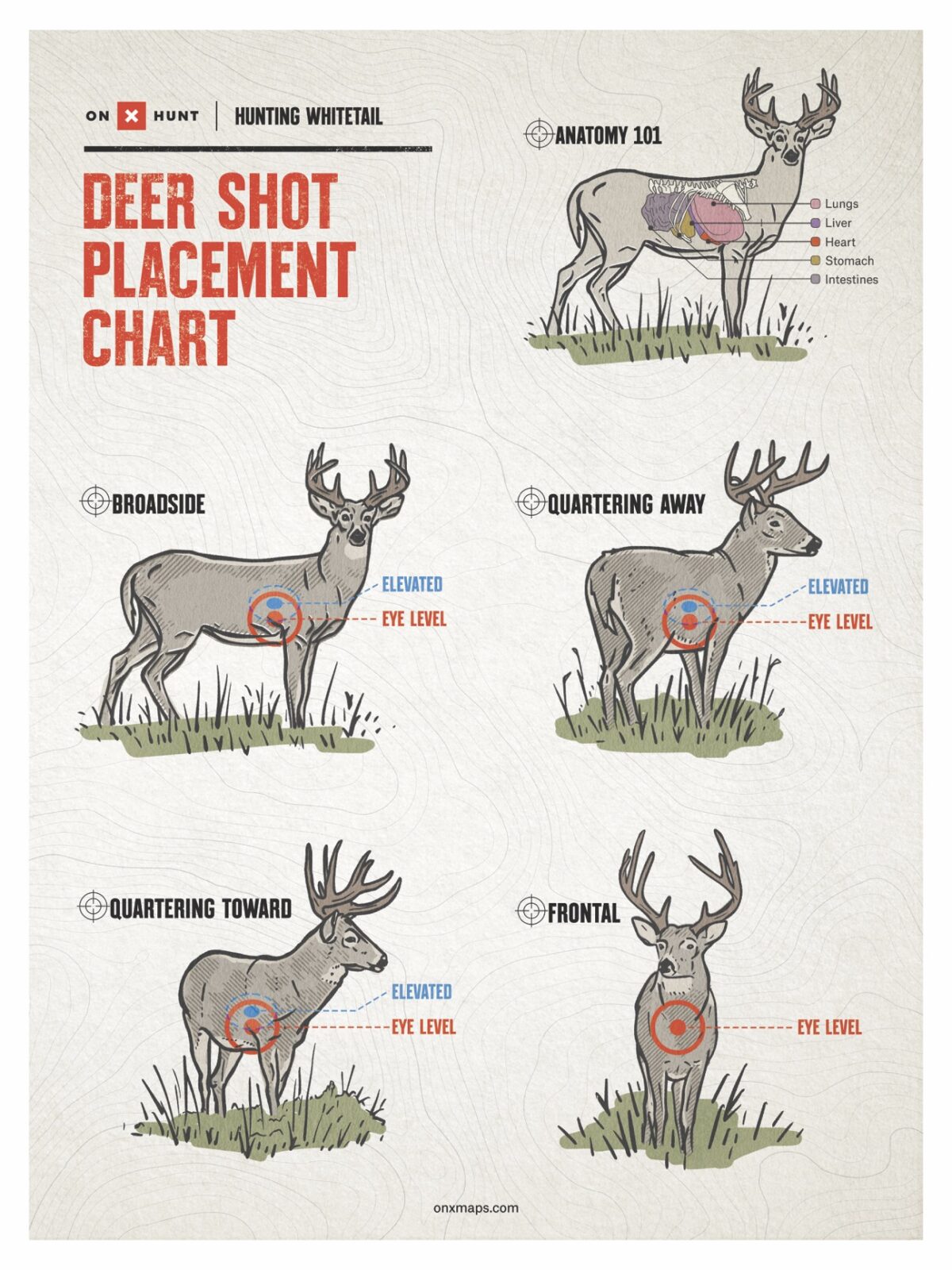
A clean kill starts with perfect shot placement.
Best Angles
- Broadside: Aim at bottom third of vitals, just behind front shoulder.
- If deer ducks, better to hit low (liver) than high (non-lethal).
- Quartering away: Pin between shoulder blades.
- 35 yards or less for bowhunters.
Use Lighted Nocks
- Provide 100% certainty of impact.
- Eliminate guesswork in blood trailing.
Read the Blood Trail
- Dark, maroon-purple blood → possible liver hit → wait 6–8+ hours.
- Green or watery blood → gut hit → wait 8–12+ hours.
- Follow patiently. Assume the trail continues.
Let the animal fully expire before approaching.
Adopt the Right Mindset—Patience Wins
Success isn’t just gear—it’s mental.
Fred Bear’s Ten Commandments
- Don’t step on anything you can step over.
- Don’t look for deer; look for movement.
- Always approach downwind.
- Best camouflage: “Sit down and be quiet!”
- Carry only gear that helps you hunt longer, harder, smarter.
- Rain isn’t a reason to quit—it’s a reason to stay.
- Camouflage appearance, sound, and scent.
- Be sure of your shot.
- Hunt where deer are, not where you imagine them.
- Next year’s hunt begins the minute this season ends.
Patience Pays Off
- One hunter walked out at dark on Halloween after 6 weeks—killed a buck the next evening.
- Another got a monster buck on the final night of 2017.
- Time in the woods = more sightings = more opportunities.
Final Whitetail Hunting Tips
- Time in the woods is your greatest advantage.
- Respect wind, weather, and deer instincts.
- Be patient, quiet, and prepared.
- Hunt smarter, not harder.
- Stack the deck: scout hard, control scent, plan meticulously.
- Learn from others—wisdom comes from shared experience.
“There’s nothing like staring down your arrow at a giant whitetail buck. Your instincts kick in, actions become second nature, and all preparation is tested tenfold.”
One hunter has taken all 29 species of North American big game with a longbow—yet still says November rut hunts are his favorite time of year.
That’s the magic of whitetail hunting.
Now go make your own story.

0 Comments